The following researchers are funded in the RING Project by the German Research Foundation
Dr.-Ing. Mina Clara Zang is a postdoctoral researcher at the Institute of Geodesy (IfE), Leibniz University Hannover. She completed her doctoral studies at Leibniz University Hannover. Her research has focused on Lunar Laser Ranging (LLR) as a tool for Earth–Moon system dynamics, geodetic parameter determination, relativistic tests, and lunar time-scale modelling. Relevant work included tests of the equivalence principle and investigations of other relativistic effects using LLR, including a possible temporal variation of the gravitational constant. Her doctoral research concerned an advanced LLR technique, Differential Lunar Laser Ranging (DLLR), with emphasis on its characteristics and its combination with standard LLR for improved parameter estimation. More recently, her research has extended to the determination of Earth orientation parameters from LLR observations and to accurate modelling of clock frequency comparison between the Earth and the Moon. The work demonstrates the potential role of LLR for fundamental physics as well as for future lunar time-scale and lunar navigation applications that all will now be enhanced by RING project P4.
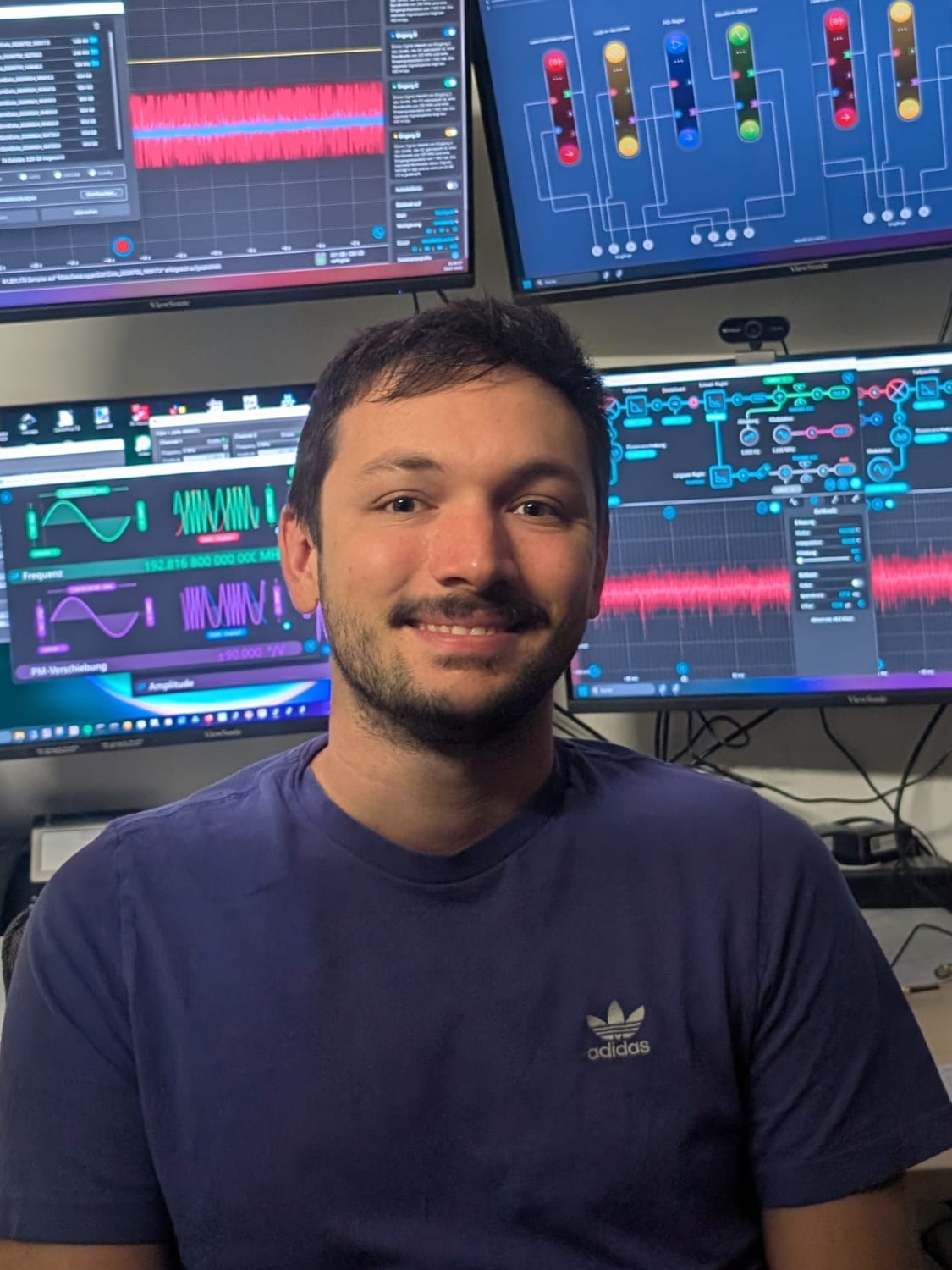
Jannik Zenner studied at RWTH Aachen and joined the Quantum Metrology research group in 2023. Together with Ulli Scheiber and Andreas Brotzer, he installed the 4-meter GeoRG ring laser, which is based on the GeoSensor design, in the basement of the Physics Institute. He has developed and implemented a range of technological advances, including the stabilization of the scale factor and the passive operation using the Hänsch-Couillaud and Pound-Drever-Hall locking methods. Importantly, he can operate the GeoRG ring laser in hybrid (active and passive) mode, making is a worldwide unique platform for technology development. He is working in RING project P1.
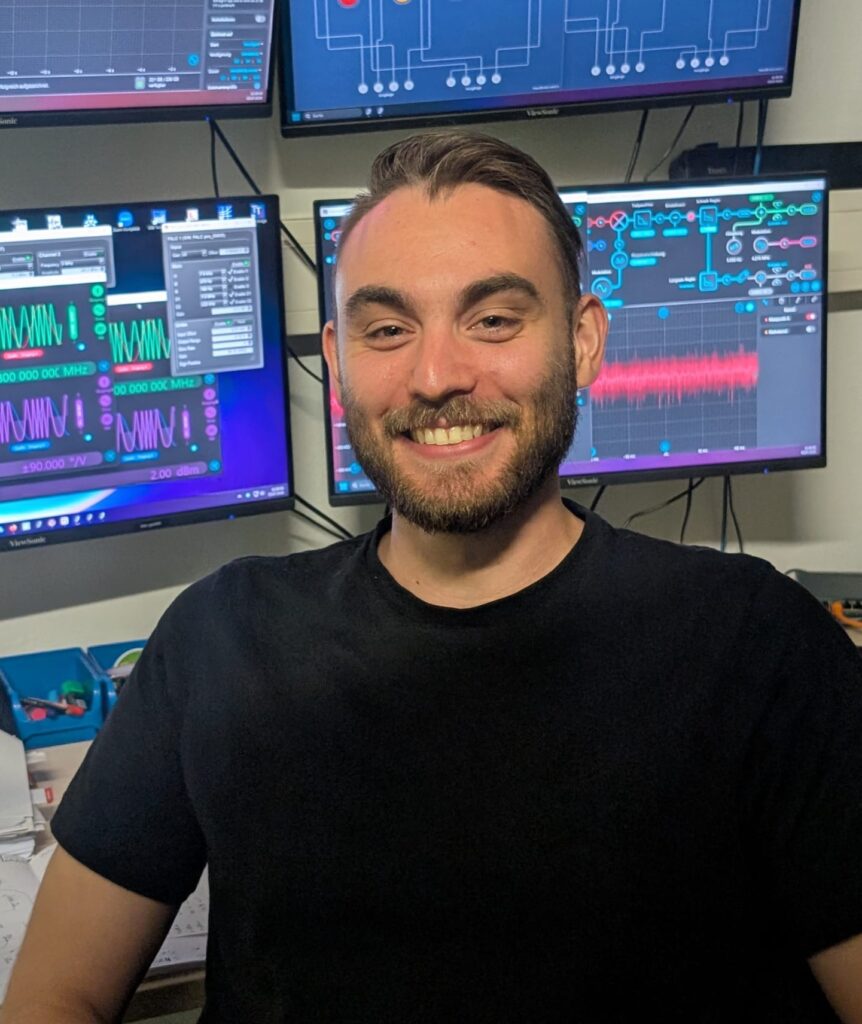
Thomas Gereons studies at the University of Bonn and joined the ring laser community in late 2024: first as an internship, then for a master thesis, and currently as a PhD student. Thomas has developed the world’s first three dimensional array of passive ring laser gyroscopes that allows for a full reconstruction of the rotation vector, and is currently optimizing the sensor for sensitivity and stability. He will contribute to the development of transportable sensors in P2, aiming for seismological measurements at observatories outside the quantum optics lab. Together with Jannik and Ulli, he upgraded the C-II ring in Christchurch for passive operation. He is working in RING project P2.
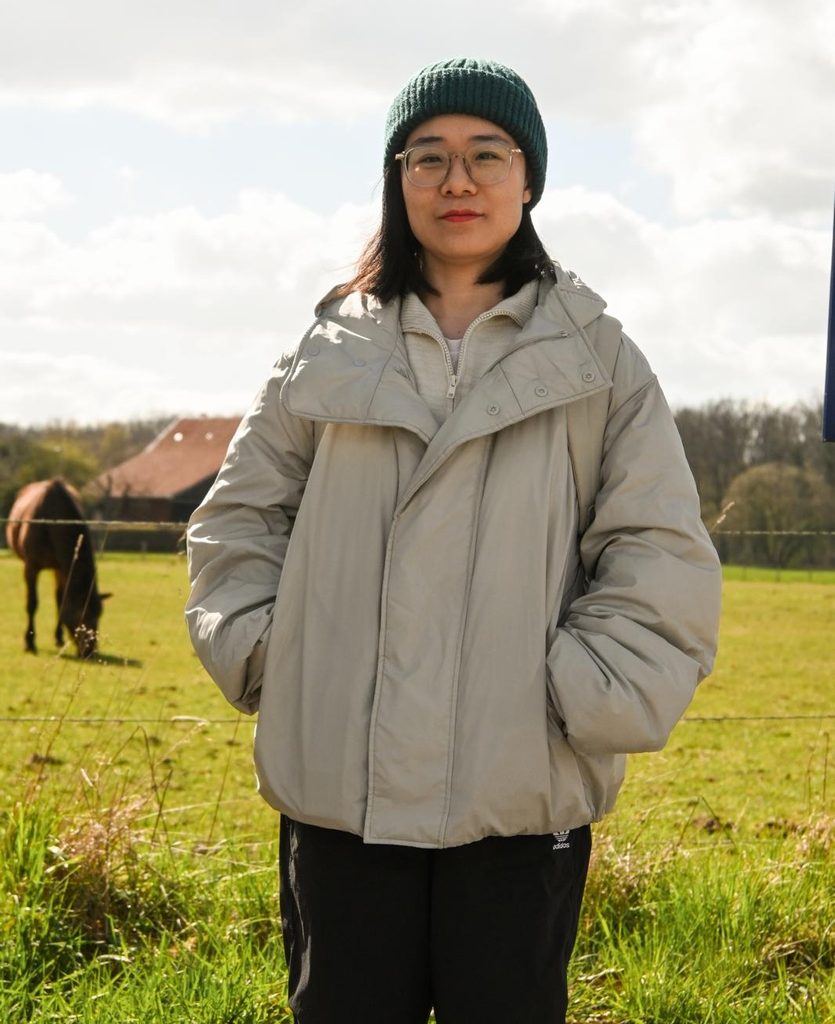
Le Tang studied physics at the Southern University of Science and Technology (SUSTECH Shenzhen, China) finishing with theoretical work in using rotational ground motion observation for seismic interferometry. He continued as a PhD student in the EU-funded SPIN doctoral training network based at the Ludwig-Maximilians-University Munich. He pioneered the use of 6 DoF observations for the determination of anisotropic properties both using seismic events and background noise. This was followed by a postdoctoral project in Paris at the University Gustave Eiffel. He is working as a postdoc in Hamburg in RING project P5. Expected starting date November 1, 2026.

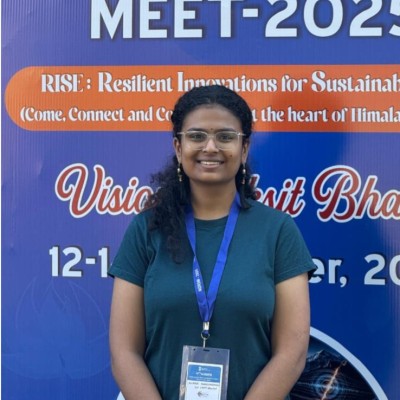
Ananya Anandharaman did a Master in Technology specializing in Applied Geophysics at the Indian Institue of Technology in Dhanbad, India. In her Master thesis she worked on “Seismic Noise Source Localisation using Sensor Array for Gravitational Wave Detectors”. Since March 2026 she is working in the LIGO GETGO Program in Glasgow, Scotland, Retraining the GravitySpy Attention-based deep learning classifier on O4 LIGO data for automated glitch identification in gravitational wave strain data. Ananya will be working at the Ludwig-Maximilians University Munich on all aspects of 6 DoF wave propagation using ring laser (and other) observations understanding complete (weak motion) seismic wavefields with applications in seismology and gravitational wave detection facilities. She will work in RING project P5. Expected starting data October 1, 2026.